

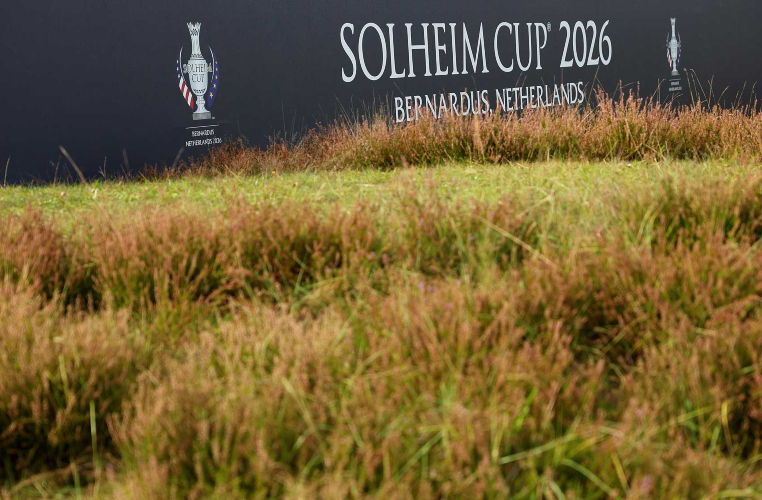
Bernardus Golf has been likened to a lot of different styles of golf course so far this week at the 2026 Solheim Cup.
Rolex Women’s World Golf Rankings No.1 Nelly Korda and her caddie, Jason McDede, thought it favored a venue one might find Down Under.
“It is a pretty tough golf course,” quipped the American in her pre-tournament press conference. “We’ve played it in all sorts of weather, especially (on Wednesday). It’s very narrow off the tee, so you have to hit it really good off the tee. (Jason) and I said it reminds us of like a golf course in Australia, where there’s a lot of penalizing bunkers. But it also has a linksy feel to it.”
Two-time LPGA Tour winner and European Solheim Cup rookie Lottie Woad, agreed with Korda’s links-golf comparison, having come from a part of the world where links golf is highly favored.
“I would say it’s heathland. Kind of links. There’s a lot of courses like that around where I live,” said Woad. “I compare it to Hankley Common, but I don’t think people know that golf course. I would say it’s more of a second-shot golf course with a lot of runoffs everywhere, and the wind playing a big factor.”
U.S. Solheim Cup Captain Angela Stanford already had a pretty good understanding of the difficulties Bernardus might present, even after bands of inclement weather dumped a couple inches worth of water on the property early in the week.
“I think I get the feeling it’s going to play firm and fast,” said Stanford. “Even if we get some rain, I still think it’s going to play firm and fast. I think that’s how it’s meant to be played.”
Stanford’s assessment was spot on, as that’s exactly the goal the Bernardus agronomy team has for the course’s Solheim Cup debut – a bouncy, heathland test of golf that challenges all 24 athletes competing in the 20th edition of the biennial team competition as it visits the Netherlands for the very first time in 2026.
Bernardus Golf is the brainchild of course designer Kyle Phillips, who also has properties like The Grove in England and Kingbarns Golf Links in Scotland to his credit, both of which this week’s venue very much mimic.
The property is gorgeous, tucked in between swaths of farmland and Cape Dutch houses that pepper the landscape in this part of the Netherlands, situated south of the country’s capital, Amsterdam. The birdsong ping-ponging through the trees sounds like it was recorded and looped by a Hollywood studio, and if you listen closely, you can even hear the whinnies of the horses that live nearby enough to cut through the stillness that wraps around the place like a blanket.
Bernardus is peaceful, a serenity both the American and European teams are hoping to disrupt as early as possible during competition days, as fans roar for every made birdie and lament every unfortunate misstep. It’s a fairly flat patch of land for spectators to walk, and there are plenty of opportunities to see multiple golf holes via any one of the vantage points sprinkled throughout the golf course.
Visually, green and brown are the primary colors that are the focal point around Bernardus, only occasionally broken up by the brackish hue of the various water hazards that threaten the lives of tee balls and approach shots and the soft brown tones of the several many bunkers that require near-perfect precision to entirely avoid.
Like the whole of the Netherlands, Bernardus puts a premium on sustainability, adopting a “brown is the new green” mentality that allows them to use less resources than normal to maintain the golf course. They don’t put any chemicals down on the property, instead choosing to monitor the health of the golf course by consistently checking the bacteria and fungi in their soil.
The greens and fairways are framed by short, sandy dunes that are peppered with fescue and gorse; two plants strategically chosen because of their need for little water. And while the course is a straightforward walk where everything is right out there in front of you, many of the fairways have undulation in them that could prove tricky for the 24 athletes competing throughout the week in the Solheim Cup, as do the putting surfaces.
Because Bernardus plays a bit shorter than some of the other venues the biennial team competition has traveled to in the 19 previous playings of this event, many of the 2026 competitors predict the property will give up quite a few birdies, under-par action that always makes for an exciting match-play venue. And it’s that fact that has Bernardus primed to be a scintillating stage for the world’s best athletes as they battle it out for love of team and love of country.
“It’s a really good match play course. I feel like there’s a lot of variety,” said Maja Stark, who is representing the Euros in her third Solheim Cup in the Netherlands. “Some longer par 5s, some shorter par 5s. It feels like they can move the tees around a lot, so they can kind of play it however they want to.”
American Andrea Lee had a similar sentiment, particularly concerning the closing stretch. “Sixteen I think will garner a lot of drama just because it’s a reachable par 5 with a water hazard running through in the front, and there’s a bunker on right,” she said. “So I feel like there could be some drama, maybe potential eagles, potential birdies, or some water balls. But that one stood out to me.
“The rest of the course, it’s a really fun match play course. I think it’s going to require accuracy off the tee, and the greens are very undulated, so just getting those speeds down. But I think it’s going to be a little bit of a shoot-out too. I think we’re going to have to make a lot of putts to win.”
While they have yet to see a course like Bernardus in the rotation for this iconic team-play event, women’s golf fans are incredibly familiar with how things roll at Solheim Cups. No matter the country or the captain, the team or the venue, drama always rears its head during this one week in September.
And this time, that cinema will all play out with Bernardus Golf at its center.